


















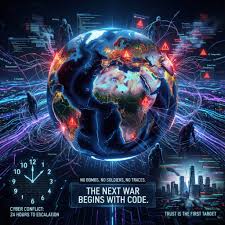
From damaged undersea cables and satellite jamming to cyberattacks and government-imposed internet shutdowns, the systems connecting the modern world are increasingly becoming targets of conflict, sabotage and political control.
Global communication relies on an enormous but largely invisible network of undersea cables, satellites, mobile towers, data centres and internet-routing systems. Together, these systems carry financial transactions, emergency information, government communications and everyday conversations across continents.
Yet the infrastructure connecting the world is more vulnerable than it appears.
The world’s communications may not collapse all at once. Instead, they could unravel quietly—disrupted at the points where technology, geography and human security are most fragile.
The hidden cables beneath the sea
Deep beneath the ocean’s surface lies the physical backbone of the internet: hundreds of undersea fibre-optic cables stretching across thousands of kilometres.
These thin strands of glass carry the overwhelming majority of international data traffic, including banking transactions, government information, business operations and personal communications. Although satellites play an important role, particularly in remote areas, most communication between continents still travels beneath the sea.
This dependence creates a serious security risk.
Undersea cables can be damaged accidentally by fishing equipment, ship anchors, natural disasters or technical failures. However, growing geopolitical tensions have also raised concerns about deliberate sabotage, surveillance and interference with critical cable routes.
One damaged cable may cause only temporary delays where alternative routes are available. But coordinated attacks or multiple failures could isolate regions, slow financial systems and severely disrupt countries with limited communications infrastructure.
Governments and international organisations have therefore begun treating undersea cables not simply as commercial assets, but as critical infrastructure requiring greater protection, monitoring and international cooperation. The European Commission, for example, has introduced measures covering cable mapping, risk assessment and stress testing. European Commission
Conflict above the clouds
Above the Earth, another struggle is taking place.
Satellites once appeared to be untouchable watchtowers of global communication. Today, they face cyberattacks, signal interference, electronic jamming and deliberate attempts to deceive navigation systems.
Powerful signals transmitted from the ground can interfere with satellite communications and disrupt positioning services. GPS spoofing can cause navigation systems to display false locations, while jamming can prevent devices from receiving reliable signals altogether.
The consequences extend far beyond the military. Aircraft, ships, emergency responders, telecommunications companies and ordinary drivers all depend on satellite-based navigation and timing systems.
During periods of conflict, interference with these systems can leave civilians without reliable directions, disrupt transportation networks and weaken communication between military units. A battle fought through radio frequencies can therefore produce serious consequences on the ground without a single satellite being physically destroyed.
Cyberattacks against communication networks
In the digital realm, the front line is everywhere.
The internet depends on protocols designed to move information rapidly between interconnected networks. Some of these systems were created when the internet was smaller and security threats were far less sophisticated.
Attackers can exploit weaknesses in internet-routing systems to redirect data through unauthorised networks. This may allow them to monitor traffic, interrupt services or send users towards

