














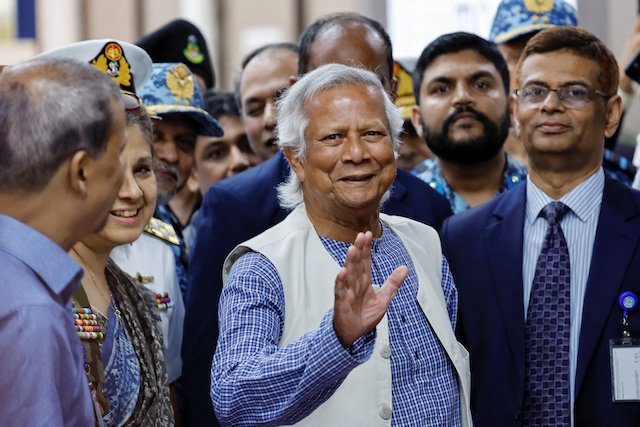
Nobel Peace Prize laureate Muhammad Yunus, 84, was sworn in on Thursday as the leader of Bangladesh’s interim government, following the overthrow of Prime Minister Sheikh Hasina after a student-led uprising. The ceremony took place at the presidential palace in Dhaka, where Yunus vowed to restore democracy and uphold the constitution in front of political and civil society leaders, military officials, and diplomats.
Earlier that day, Yunus returned to Bangladesh from Europe, hailing the ousting of Hasina as the country’s “second independence.” He emphasized the importance of restoring law and order after weeks of violent protests that left at least 455 people dead, calling on citizens to protect each other, including minority groups.
“Our first task is to fix the law and order situation,” Yunus stated. “If you trust in me, ensure that there are no attacks against anyone, anywhere in the country. Every person is our brother, and our task is to protect them.”
Yunus was joined by more than a dozen members of his cabinet, including leaders from the Students Against Discrimination group, which had been at the forefront of the protests. The military, which played a crucial role in Hasina’s ouster, has shown support for Yunus, with Army Chief General Waker-Uz-Zaman expressing confidence in his ability to guide the nation through a democratic transition.
The military’s shift in allegiance was a decisive factor in Hasina’s downfall. Following her departure to India, the military agreed to student demands for Yunus to lead the interim government. Parliament has been dissolved, and key figures in Hasina’s administration, including the police chief, have been removed.
Yunus, who won the Nobel Peace Prize in 2006 for his pioneering work in microfinance, faces the challenge of steering Bangladesh back to stability and democracy. His leadership marks a significant moment in the country’s history, with hopes for a “beautiful democratic process” expressed by both the military and the citizens of Bangladesh.

